Is Owen hard to read?
Packer describes Owen’s style and why it can be hard to read:
There is no denying that Owen is heavy and hard to read. This is not so much due to obscure arrangement as to two other factors. The first is his lumbering literary gait. ‘Owen travels through it [his subject] with the elephant’s grace and solid step, if sometimes also with his ungainly motion,’ says Thomson. That puts it kindly. Much of Owen’s prose reads like a roughly-dashed-off translation of a piece of thinking done in Ciceronian Latin. It has, no doubt, a certain clumsy dignity; so has Stonehenge; but it is trying to the reader to have to go over sentences two or three times to see their meaning, and this necessity makes it much harder to follow an argument. The present writer, however, has found that the hard places in Owen usually come out as soon as one reads them aloud. The second obscuring factor is Owen’s austerity as an expositor. He has a lordly disdain for broad introductions which ease the mind gently into a subject, and for comprehensive summaries which gather up scattered points into a small space. He obviously carries the whole of his design in his head, and expects his readers to do the same. Nor are his chapter divisions reliable pointers to the discourse, for though a change of subject is usually marked by a chapter division, Owen often starts a new chapter where there is no break in the thought at all. Nor is he concerned about literary proportions; the space given to a topic is determined by its intrinsic complexity rather than its relative importance, and the reader is left to work out what is basic and what is secondary by noting how things link together…. (Packer, Quest for Godliness, 147)
Spurgeon argued that “condensed” is the appropriate adjective to describe Owen’s writings. “His style is condensed because he gives notes of what he might have said, and passes on without fully developing the great thoughts of his capacious mind.” (Spurgeon, Commenting and Commentaries, 103)
Then why read him?
Spurgeon addressed this question once: “I did not say that it was easy to read them!—that would not be true; yet I do venture to say that the labour involved in plodding through these ill-arranged and tediously-written treatises will find them abundantly worthwhile." (Spurgeon, Commenting and Commentaries, 84)
Why should I read Owen on sanctification in particular?
Here are some testimonies from those who have been profoundly changed by Owen’s writings on sin:
“John Owen’s treatises on Indwelling Sin in Believers and The Mortification of Sin are, in my opinion, the most helpful writings on personal holiness ever written.” —Jerry Bridges
“I owe more to John Owen than to any other theologian, ancient or modern, and I owe more to this little book [The Mortification of Sin] than to anything else he wrote.” —J.I. Packer
“I assert unhesitatingly that the man who wants to study experimental theology will find no books equal to those of Owen for complete scriptural and exhaustive treatment of the subjects they handle. If you wish to study thoroughly the doctrine of sanctification I make no apology for strongly recommending Owen on the Holy Spirit.” —J. C. Ryle
Do you have any advice on reading Owen?
We’ll let J. I. Packer answer this question, too:
Owen’s style is often stigmatized as cumbersome and tortuous. Actually it is Latinised spoken style, fluent but stately and expansive, in the elaborate Ciceronian style. When Owen’s prose is read aloud, as didactic rhetoric (which is, after all, what it is), the verbal inversions, displacements, archaisms and new coinages that bother modern readers cease to obscure and offend. Those who think as they read find Owen’s expansiveness suggestive and his fulsomeness fertilising. (Packer, Quest for Godliness, 194)
For whom, then, did Owen write?
His studied unconcern about style in presenting his views, a conscientious protest against the self-conscious literary posturing of the age, conceals their uncommon clarity and straightforwardness from superficial readers; but then, Owen did not write for superficial readers. He wrote, rather, for those who, once they take up a subject, cannot rest till they see to the bottom of it, and who find exhaustiveness not exhausting, but satisfying and refreshing. (Packer, Quest for Godliness, 193)
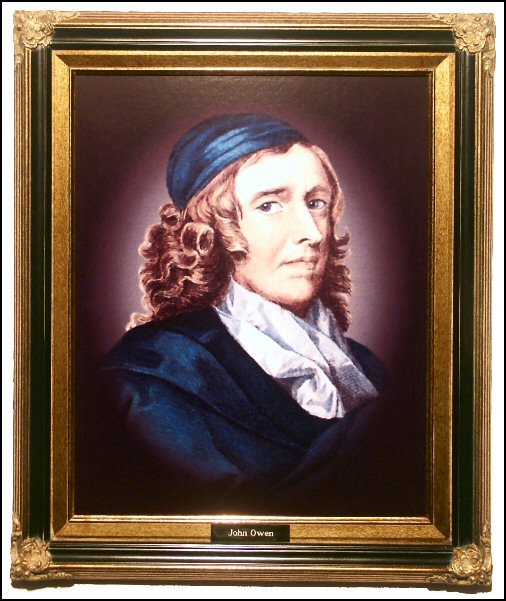
How was Owen’s character and appearance described?
John Asty passes along this description:
As to his person his stature was tall, his visage grave and majestic and withal comely: he had the aspect and deportment of a gentleman, suitable to his birth. He had a very large capacity of mind, a ready invention, a good judgement, a great natural wit which being improved by education, rendered him a person of incomparable abilities. As to his temper he was very affable and courteous, familiar and sociable; the meanest persons found an easy access to his converse and friendship. He was facetious and pleasant in his common discourse, jesting with his acquaintance but with sobriety and measure; a great master of his passions especially that of anger; he was of a serene and even temper, neither elated with honour, credit, friends, or estate, nor depressed with troubles and difficulties. (Cited in Toon, God’s Statesmen, 176)
Who were the Puritans?
Puritanism was at heart a spiritual movement, passionately concerned with God and godliness. It began in England with William Tyndale the Bible translator, Luther’s contemporary, a generation before the word “Puritan” was coined, and it continued till the latter years of the seventeenth century, some decades after “Puritan” had fallen out of use. . . . Puritanism was essentially a movement for church reform, pastoral renewal and evangelism, and spiritual revival. . . . The Puritan goal was to complete what England’s Reformation began: to finish reshaping Anglican worship, to introduce effective church discipline into Anglican parishes, to establish righteousness in the political, domestic, and socio-economic fields, and to convert all Englishmen to a vigorous evangelical faith. (A Quest for Godliness, p. 28)
Which authors most influenced Owen?
According to Sebastian Rehnman: Owen’s writings refer to numerous Reformed thinkers, and his library contained hundreds of volumes of Reformed works. Some criteria are necessary in evaluating what authors had most influence on him, and if we take at least five affirmative references to or quotations from actual works as criterium [sic], which would seem to be a low and reasonable place to start, the list becomes surprisingly short: William Ames (1576-1633), Theodore Beza (1519-1605), John Calvin (1509-1564), Franciscus Junius (1545-1602), Johannes Piscator (1546-1626), Gisbert Voetius (1589-1676), and Hieronymus Zanchius (1516-1590). . . . Judging from Owen’s own remarks, he regarded Martin Bucer (1491-1551), John Calvin, Peter Martyr Vermigli (1500-1562), and Theodore Beza, as the “principle” authors [Owen, Works IV.229] (Rehnman, Divine Discourse, 21, 22)
Was there a "center" to Owen’s theology?
Richard Daniels, who wrote in his dissertation on The Christology of John Owen: …there is one motif so important to John Owen, so often and so broadly cited by him, that the writer would go so far as to call it the focal point of Owen’s theology…. namely, the doctrine that in the gospel we behold, by the Christ-given Holy Spirit, the glory of God "in the face of Christ" and are thereby changed into his image…. (92) …the knowledge of Christ was the all-surpassing object of Owen’s desires, the center of his doctrinal system, and the end, means, and indispensable prerequisite for Christian theology. (516)
What was the driving factor in Owen’s ministry?
Steve Griffiths, in Redeem the Time, writes:
To date, no one has yet managed to reveal Owen the man. In an attempt to meet this challenge, new questions have had to be asked of Owen and a new premise has had to be sought in approaching his writings, namely: what was of fundamental importance to Owen and what was his primary motivation in ministry? The answer is blindingly simple. Owen was a pastor. Of fundamental importance to him was the spiritual growth of those amongst whom he ministered. His primary motivation was the growth in holiness of his flock. Everything else stems from that truth. He was not primarily concerned with unswerving faithfulness, or otherwise, to Calvin, Aristotle or Augustine. He was not fundamentally concerned with loyalty to any one theological position. Owen’s first loyalty was to no man. God was his judge and he was acutely aware that he would be judged on his performance as a minister of the gospel. (13)
Sinclair Ferguson, in John Owen on the Christian Life, echoes a similiar sentiment: “My own reading of Owen has convinced me that everything he wrote for his contemporaries had a practical and pastoral aim in view—the promotion of true Christian living” (xi). As David Clarkson said in his funeral sermon for Owen, "I need not tell you of this who knew him, that it was his great Design to promote Holiness in the Life and Exercise of it among you."
What were Owen’s final days like?
On August 22, 1683, at his home in Ealing, Owen dictated his last surviving letter to his long-time friend, Charles Fleetwood:
I am going to him whom my soul hath loved, or rather hath love me with an everlasting love; which is the whole ground of all my consolation. The passage is very irksome and wearisome through strong pain of various sorts which are all issued in an intermitting fever. All things were provided to carry me to London today attending to the advice of my physician, but we were all disappointed by my utter disability to understand the journey. I am leaving the ship of the church in a storm, but while the great Pilot is in it the loss of a poore under-rower will be inconsiderable. Live and pray and hope and waite patiently and doe not despair; the promise stands invincible that he will never leave thee nor forsake thee. (Toon, The Correspondence of John Owen, 174)
Two days later Owen’s friend William Payne, who was overseeing the printing of The Glory of Christ, paid him a visit, assuring him that all was going well with the publication. Owen responded:
I am glad to hear it; but O brother Payne! The long wished-for day is come at last, in which I shall see the glory in another manner than I have ever done, or was capable of doing in the world.
These were Owen’s last recorded words. He died on August 24, 1683—St. Bartholomew’s Day—exactly twenty years after the Great Ejection of the Puritans. On September 4, Owen was buried in Bunhill Fields.
Where is Owen’s grave?
Owen was buried in Bunhill Fields, in London. To see pictures of his grave, click here and here. You can view also view a map of Bunhill Fields to see where Owen is buried in relation to Bunyan, Cromwell, and others.
What is the translation of the Latin epigraph on Owen’s grave?
Found in Works I.cxiii f. this is, in Packer’s terms, "not a translation in the ordinary present-tense sense, but a loose explanatory amplification":
John Owen, born in Oxfordshire, son of a distinguished theologian, was himself a more distinguished one, who must be counted among the most distinguished of this age. Furnished with the recognised resources of humane learning in uncommon measure, he put them all, as a well-ordered array of handmaids, at the service of theology, which he served himself. His theology was polemical, practical, and what is called casuistical, and it cannot be said that any one of these was peculiarly his rather than another.
In polemical theology, with more than herculean strength, he strangled three poisonous serpents, the Arminian, the Socinian, and the Roman.
In practical theology, he laid out before others the whole of the activity of the Holy Spirit, which he had first experienced in his own heart, according to the rule of the Word. And, leaving other things aside, he cultivated, and realised in practice, the blissful communion with God of which he wrote; a traveller on earth who grasped God like one in heaven.
In casuistry, he was valued as an oracle to be consulted on every complex matter.
A scribe instructed in every way for the kingdom of God, this pure lamp of gospel truth shone forth on many in private, on more from the pulpit, and on all in his printed works, pointing everyone to the same goal. And in this shining forth he gradually, as he and others recognized, squandered his strength till it was gone. His holy soul, longing to enjoy God more, left the shattered ruins of his once-handsome body, full of permanent weaknesses, attacked by frequent diseases, worn out most of all by hard work, and no longer a fit instrument for serving God, on a day rendered dreadful for many by earthly powers but now made happy for him through the power of God, August 25, 1683. He was 67.
Owen is called a "Nonconformist." What does that mean?
According to Robert Oliver’s essay, "John Owen–His Life and Times":
Before 1660 the term ‘Nonconformist described an Anglican clergy-man who ignored some of the rubrics of the Book of Common Prayer, thereby avoiding what he considered to be the remnants of ‘popish superstition’. Requirements particularly obnoxious to the Puritans were the compulsory wearing of the surplice and making the sign of the cross in baptism. In the 1630s Archbishop Laud made further demands which included the railing in of the communion table at the east end of the church and bowing at the name of Jesus. Immediately after the Reformation the communion table had often been moved into the body of the church for the administration of the Lord’s Supper. Laud’s changes began to give the east end of the churches a more Romish apperance. (pp. 12-13)
Packer describes Owen’s style and why it can be hard to read:
There is no denying that Owen is heavy and hard to read. This is not so much due to obscure arrangement as to two other factors. The first is his lumbering literary gait. ‘Owen travels through it [his subject] with the elephant’s grace and solid step, if sometimes also with his ungainly motion,’ says Thomson. That puts it kindly. Much of Owen’s prose reads like a roughly-dashed-off translation of a piece of thinking done in Ciceronian Latin. It has, no doubt, a certain clumsy dignity; so has Stonehenge; but it is trying to the reader to have to go over sentences two or three times to see their meaning, and this necessity makes it much harder to follow an argument. The present writer, however, has found that the hard places in Owen usually come out as soon as one reads them aloud. The second obscuring factor is Owen’s austerity as an expositor. He has a lordly disdain for broad introductions which ease the mind gently into a subject, and for comprehensive summaries which gather up scattered points into a small space. He obviously carries the whole of his design in his head, and expects his readers to do the same. Nor are his chapter divisions reliable pointers to the discourse, for though a change of subject is usually marked by a chapter division, Owen often starts a new chapter where there is no break in the thought at all. Nor is he concerned about literary proportions; the space given to a topic is determined by its intrinsic complexity rather than its relative importance, and the reader is left to work out what is basic and what is secondary by noting how things link together…. (Packer, Quest for Godliness, 147)
Spurgeon argued that “condensed” is the appropriate adjective to describe Owen’s writings. “His style is condensed because he gives notes of what he might have said, and passes on without fully developing the great thoughts of his capacious mind.” (Spurgeon, Commenting and Commentaries, 103)
Then why read him?
Spurgeon addressed this question once: “I did not say that it was easy to read them!—that would not be true; yet I do venture to say that the labour involved in plodding through these ill-arranged and tediously-written treatises will find them abundantly worthwhile." (Spurgeon, Commenting and Commentaries, 84)
Why should I read Owen on sanctification in particular?
Here are some testimonies from those who have been profoundly changed by Owen’s writings on sin:
“John Owen’s treatises on Indwelling Sin in Believers and The Mortification of Sin are, in my opinion, the most helpful writings on personal holiness ever written.” —Jerry Bridges
“I owe more to John Owen than to any other theologian, ancient or modern, and I owe more to this little book [The Mortification of Sin] than to anything else he wrote.” —J.I. Packer
“I assert unhesitatingly that the man who wants to study experimental theology will find no books equal to those of Owen for complete scriptural and exhaustive treatment of the subjects they handle. If you wish to study thoroughly the doctrine of sanctification I make no apology for strongly recommending Owen on the Holy Spirit.” —J. C. Ryle
Do you have any advice on reading Owen?
We’ll let J. I. Packer answer this question, too:
Owen’s style is often stigmatized as cumbersome and tortuous. Actually it is Latinised spoken style, fluent but stately and expansive, in the elaborate Ciceronian style. When Owen’s prose is read aloud, as didactic rhetoric (which is, after all, what it is), the verbal inversions, displacements, archaisms and new coinages that bother modern readers cease to obscure and offend. Those who think as they read find Owen’s expansiveness suggestive and his fulsomeness fertilising. (Packer, Quest for Godliness, 194)
For whom, then, did Owen write?
His studied unconcern about style in presenting his views, a conscientious protest against the self-conscious literary posturing of the age, conceals their uncommon clarity and straightforwardness from superficial readers; but then, Owen did not write for superficial readers. He wrote, rather, for those who, once they take up a subject, cannot rest till they see to the bottom of it, and who find exhaustiveness not exhausting, but satisfying and refreshing. (Packer, Quest for Godliness, 193)
How was Owen’s character and appearance described?
John Asty passes along this description:
As to his person his stature was tall, his visage grave and majestic and withal comely: he had the aspect and deportment of a gentleman, suitable to his birth. He had a very large capacity of mind, a ready invention, a good judgement, a great natural wit which being improved by education, rendered him a person of incomparable abilities. As to his temper he was very affable and courteous, familiar and sociable; the meanest persons found an easy access to his converse and friendship. He was facetious and pleasant in his common discourse, jesting with his acquaintance but with sobriety and measure; a great master of his passions especially that of anger; he was of a serene and even temper, neither elated with honour, credit, friends, or estate, nor depressed with troubles and difficulties. (Cited in Toon, God’s Statesmen, 176)
Who were the Puritans?
Puritanism was at heart a spiritual movement, passionately concerned with God and godliness. It began in England with William Tyndale the Bible translator, Luther’s contemporary, a generation before the word “Puritan” was coined, and it continued till the latter years of the seventeenth century, some decades after “Puritan” had fallen out of use. . . . Puritanism was essentially a movement for church reform, pastoral renewal and evangelism, and spiritual revival. . . . The Puritan goal was to complete what England’s Reformation began: to finish reshaping Anglican worship, to introduce effective church discipline into Anglican parishes, to establish righteousness in the political, domestic, and socio-economic fields, and to convert all Englishmen to a vigorous evangelical faith. (A Quest for Godliness, p. 28)
Which authors most influenced Owen?
According to Sebastian Rehnman: Owen’s writings refer to numerous Reformed thinkers, and his library contained hundreds of volumes of Reformed works. Some criteria are necessary in evaluating what authors had most influence on him, and if we take at least five affirmative references to or quotations from actual works as criterium [sic], which would seem to be a low and reasonable place to start, the list becomes surprisingly short: William Ames (1576-1633), Theodore Beza (1519-1605), John Calvin (1509-1564), Franciscus Junius (1545-1602), Johannes Piscator (1546-1626), Gisbert Voetius (1589-1676), and Hieronymus Zanchius (1516-1590). . . . Judging from Owen’s own remarks, he regarded Martin Bucer (1491-1551), John Calvin, Peter Martyr Vermigli (1500-1562), and Theodore Beza, as the “principle” authors [Owen, Works IV.229] (Rehnman, Divine Discourse, 21, 22)
Was there a "center" to Owen’s theology?
Richard Daniels, who wrote in his dissertation on The Christology of John Owen: …there is one motif so important to John Owen, so often and so broadly cited by him, that the writer would go so far as to call it the focal point of Owen’s theology…. namely, the doctrine that in the gospel we behold, by the Christ-given Holy Spirit, the glory of God "in the face of Christ" and are thereby changed into his image…. (92) …the knowledge of Christ was the all-surpassing object of Owen’s desires, the center of his doctrinal system, and the end, means, and indispensable prerequisite for Christian theology. (516)
What was the driving factor in Owen’s ministry?
Steve Griffiths, in Redeem the Time, writes:
To date, no one has yet managed to reveal Owen the man. In an attempt to meet this challenge, new questions have had to be asked of Owen and a new premise has had to be sought in approaching his writings, namely: what was of fundamental importance to Owen and what was his primary motivation in ministry? The answer is blindingly simple. Owen was a pastor. Of fundamental importance to him was the spiritual growth of those amongst whom he ministered. His primary motivation was the growth in holiness of his flock. Everything else stems from that truth. He was not primarily concerned with unswerving faithfulness, or otherwise, to Calvin, Aristotle or Augustine. He was not fundamentally concerned with loyalty to any one theological position. Owen’s first loyalty was to no man. God was his judge and he was acutely aware that he would be judged on his performance as a minister of the gospel. (13)
Sinclair Ferguson, in John Owen on the Christian Life, echoes a similiar sentiment: “My own reading of Owen has convinced me that everything he wrote for his contemporaries had a practical and pastoral aim in view—the promotion of true Christian living” (xi). As David Clarkson said in his funeral sermon for Owen, "I need not tell you of this who knew him, that it was his great Design to promote Holiness in the Life and Exercise of it among you."
What were Owen’s final days like?
On August 22, 1683, at his home in Ealing, Owen dictated his last surviving letter to his long-time friend, Charles Fleetwood:
I am going to him whom my soul hath loved, or rather hath love me with an everlasting love; which is the whole ground of all my consolation. The passage is very irksome and wearisome through strong pain of various sorts which are all issued in an intermitting fever. All things were provided to carry me to London today attending to the advice of my physician, but we were all disappointed by my utter disability to understand the journey. I am leaving the ship of the church in a storm, but while the great Pilot is in it the loss of a poore under-rower will be inconsiderable. Live and pray and hope and waite patiently and doe not despair; the promise stands invincible that he will never leave thee nor forsake thee. (Toon, The Correspondence of John Owen, 174)
Two days later Owen’s friend William Payne, who was overseeing the printing of The Glory of Christ, paid him a visit, assuring him that all was going well with the publication. Owen responded:
I am glad to hear it; but O brother Payne! The long wished-for day is come at last, in which I shall see the glory in another manner than I have ever done, or was capable of doing in the world.
These were Owen’s last recorded words. He died on August 24, 1683—St. Bartholomew’s Day—exactly twenty years after the Great Ejection of the Puritans. On September 4, Owen was buried in Bunhill Fields.
Where is Owen’s grave?
Owen was buried in Bunhill Fields, in London. To see pictures of his grave, click here and here. You can view also view a map of Bunhill Fields to see where Owen is buried in relation to Bunyan, Cromwell, and others.
What is the translation of the Latin epigraph on Owen’s grave?
Found in Works I.cxiii f. this is, in Packer’s terms, "not a translation in the ordinary present-tense sense, but a loose explanatory amplification":
John Owen, born in Oxfordshire, son of a distinguished theologian, was himself a more distinguished one, who must be counted among the most distinguished of this age. Furnished with the recognised resources of humane learning in uncommon measure, he put them all, as a well-ordered array of handmaids, at the service of theology, which he served himself. His theology was polemical, practical, and what is called casuistical, and it cannot be said that any one of these was peculiarly his rather than another.
In polemical theology, with more than herculean strength, he strangled three poisonous serpents, the Arminian, the Socinian, and the Roman.
In practical theology, he laid out before others the whole of the activity of the Holy Spirit, which he had first experienced in his own heart, according to the rule of the Word. And, leaving other things aside, he cultivated, and realised in practice, the blissful communion with God of which he wrote; a traveller on earth who grasped God like one in heaven.
In casuistry, he was valued as an oracle to be consulted on every complex matter.
A scribe instructed in every way for the kingdom of God, this pure lamp of gospel truth shone forth on many in private, on more from the pulpit, and on all in his printed works, pointing everyone to the same goal. And in this shining forth he gradually, as he and others recognized, squandered his strength till it was gone. His holy soul, longing to enjoy God more, left the shattered ruins of his once-handsome body, full of permanent weaknesses, attacked by frequent diseases, worn out most of all by hard work, and no longer a fit instrument for serving God, on a day rendered dreadful for many by earthly powers but now made happy for him through the power of God, August 25, 1683. He was 67.
Owen is called a "Nonconformist." What does that mean?
According to Robert Oliver’s essay, "John Owen–His Life and Times":
Before 1660 the term ‘Nonconformist described an Anglican clergy-man who ignored some of the rubrics of the Book of Common Prayer, thereby avoiding what he considered to be the remnants of ‘popish superstition’. Requirements particularly obnoxious to the Puritans were the compulsory wearing of the surplice and making the sign of the cross in baptism. In the 1630s Archbishop Laud made further demands which included the railing in of the communion table at the east end of the church and bowing at the name of Jesus. Immediately after the Reformation the communion table had often been moved into the body of the church for the administration of the Lord’s Supper. Laud’s changes began to give the east end of the churches a more Romish apperance. (pp. 12-13)