Showing posts with label Calvinism. Show all posts

Thursday, May 28, 2009

THE CONTAGIOUS, INFECTIOUS DOCTRINES OF GRACE
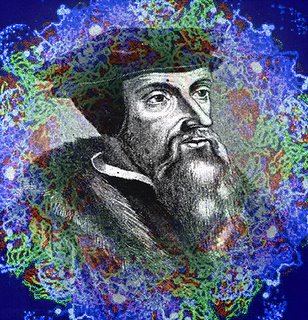
John Calvin's tulipus syndromus

updated and en encore presentation

About three years ago or so, Dr. Caner - Dean of Students at Liberty Theological Seminary, boldly asserted that "Calvinism is a virus." 

Ouch! 

Uncharitable words that sting, and to be sure, seemingly were meant to hurt, intimidate, offend, stir anger, cause division, and discourage.

But let us not fret my friends... we do not return insult for insult... amen? I think Dr. Caner's diagnosis can be meant for our good. Could he be unwittingly correct in what he is saying? Could Calvinism really be a virus - but... one that's worth catching? I say yes it is!

Here is how I would unfold his unintended acronym of V.I.R.U.S.:
V. - Vitium totalis*
I. - Irresistible Grace
R. - Restricted redemption
U. - Unconditional election
S. - Saints preserved and persevering


*(vitium, latin for: fault, moral depravity, corruption, wickedness; and, totalis, latin for: complete, total, absolute; together they = total depravity.)
There are the five points of Calvinism (the doctrines of grace) according to Dr. Caner. I actually like this acronym a lot. It gives fresh definition to an infectious, contagious faith that no earthly antibiotic can cure once it is given to you by God's sovereign predestined plan for eternal life. This is our hope and assurance in salvation isn't it? All of grace; all of God; all of Christ; all of the Holy Spirit; all by the gospel. The elect of God; the chosen by Him in Christ before the foundations of the world, sealed with the Holy Spirit unto our day of redemption.

So I want to sincerely thank Dr. Caner for challenging my thoughts and being used as an agent of God's grace in my sanctification today - for which I am grateful. 

So may we call all men everywhere to repent; to be eternally changed by the contagious life-transforming grace of the gospel of the Lord Jesus Christ that alone can arrest men's souls for eternity. 

May all Christians lives be a witness for the Lord. May we be "contagious" with the gospel; being salt and light to a lost world that so desperately needs the gospel of grace to infect their lives -- making them immune to the eternal effects of sin.

Let us go into all the world and preach the gospel!

Sola fide, sola gratia, solus Christus, sola Scriptura, soli Deo gloria!
Steve
Rom. 3:21-31

Friday, April 03, 2009

SPURGEON'S DEFENSE OF CALVINISM
...will the SBC return to the doctrines of grace?

MULLIGAN FRIDAY today goes to the Southern Baptist Convention (SBC). 

The Southern Baptist Convention in years past has faithfully stood for the inerrancy and infallibility of Scripture; has stood for holiness and integrity among its pastors; and has called generations to revival and repentance from sin. 


So then, why would they deny the doctrines of grace in salvation? Why would they contest that God is sovereign in every other aspect of life over His creation - except salvation? Why would they see the biblical doctrines of election, predestination, foreknowledge, etc. as being an impediment to evangelism rather than being essential to evangelism itself?

My prayer is that these profound biblical words of Charles Spurgeon would begin to encourage all in the SBC that are preaching a weak Arminian gospel; who have wrongly accused faithful reformed pastors in Baptist churches for being deceitful; and for those who have been given over to historical revisionism in the great Baptist tradition of faith - to repent of this error, recover their Calvinistic history, return to the doctrines of grace in gospel preaching, and regard the words of their Reformed Baptist patriarch, Charles Spurgeon once again.

Read now the most faithful Baptist preacher in history as he speaks from the grave to the more often than not numbers driven and pragmatic SBC of today. 

Therefore, in the spirit of Christian charity with the prayerful hope of heaven sent change one day back to the great truths of Calvinism... they are awarded a mulligan.

Let's Not Forsake the Old Paths--and Be Careful to Walk in Them,
SJ Camp
Romans 8:28-31


A Defense of Calvinism
by C.H. Spurgeon

The old truth that Calvin preached, that Augustine preached, that Paul preached, is the truth that I must preach today, or else be false to my conscience and my God. I cannot shape the truth; I know of no such thing as paring off the rough edges of a doctrine. John Knox's gospel is my gospel. That which thundered through Scotland must thunder through England again.

IT IS A GREAT THING to begin the Christian life by believing good solid doctrine. Some people have received twenty different "gospels" in as many years; how many more they will accept before they get to their journey's end, it would be difficult to predict. I thank God that He early taught me the gospel, and I have been so perfectly satisfied with it, that I do not want to know any other. Constant change of creed is sure loss. If a tree has to be taken up two or three times a year, you will not need to build a very large loft in which to store the apples. When people are always shifting their doctrinal principles, they are not likely to bring forth much fruit to the glory of God. It is good for young believers to begin with a firm hold upon those great fundamental doctrines which the Lord has taught in His Word. Why, if I believed what some preach about the temporary, trumpery salvation which only lasts for a time, I would scarcely be at all grateful for it; but when I know that those whom God saves He saves with an everlasting salvation, when I know that He gives to them an everlasting righteousness, when I know that He settles them on an everlasting foundation of everlasting love, and that He will bring them to His everlasting kingdom, oh, then I do wonder, and I am astonished that such a blessing as this should ever have been given to me!

"Pause, my soul! adore, and wonder!
Ask, 'Oh, why such love to me?'
Grace hath put me in the number of the Saviour's family:
Hallelujah! Thanks, eternal thanks, to Thee!"

I suppose there are some persons whose minds naturally incline towards the doctrine of free-will. I can only say that mine inclines as naturally towards the doctrines of sovereign grace.

The Gratitude that Springs from Sovereign Grace
Sometimes, when I see some of the worst characters in the street, I feel as if my heart must burst forth in tears of gratitude that God has never let me act as they have done! I have thought, if God had left me alone, and had not touched me by His grace, what a great sinner I should have been! I should have run to the utmost lengths of sin, dived into the very depths of evil, nor should I have stopped at any vice or folly, if God had not restrained me. I feel that I should have been a very king of sinners, if God had let me alone. I cannot understand the reason why I am saved, except upon the ground that God would have it so. I cannot, if I look ever so earnestly, discover any kind of reason in myself why I should be a partaker of Divine grace. If I am not at this moment without Christ, it is only because Christ Jesus would have His will with me, and that will was that I should be with Him where He is, and should share His glory. I can put the crown nowhere but upon the head of Him whose mighty grace has saved me from going down into the pit.

Looking back on my past life, I can see that the dawning of it all was of God; of God effectively. I took no torch with which to light the sun, but the sun enlightened me. I did not commence my spiritual life-no, I rather kicked, and struggled against the things of the Spirit: when He drew me, for a time I did not run after Him: there was a natural hatred in my soul of everything holy and good. Wooings were lost upon me-warnings were cast to the wind-thunders were despised; and as for the whispers of His love, they were rejected as being less than nothing and vanity. But, sure I am, I can say now, speaking on behalf of myself, "He only is my salvation." It was He who turned my heart, and brought me down on my knees before Him.

I can in very deed, say with Doddridge and Toplady - "Grace taught my soul to pray, and made my eyes o'erflow;" and coming to this moment, I can add - 'Tis grace has kept me to this day, and will not let me go.'

Born, as all of us are by nature, an Arminian
Well can I remember the manner in which I learned the doctrines of grace in a single instant. Born, as all of us are by nature, an Arminian, I still believed the old things I had heard continually from the pulpit, and did not see the grace of God. When I was coming to Christ, I thought I was doing it all myself, and though I sought the Lord earnestly, I had no idea the Lord was seeking me. I do not think the young convert is at first aware of this.

I can recall the very day and hour when first I received those truths in my own soul-when they were, as John Bunyan says, burnt into my heart as with a hot iron, and I can recollect how I felt that I had grown on a sudden from a babe into a man-that I had made progress in Scriptural knowledge, through having found, once for all, the clue to the truth of God. One week-night, when I was sitting in the house of God, I was not thinking much about the preacher's sermon, for I did not believe it. The thought struck me, How did you come to be a Christian? I sought the Lord. But how did you come to seek the Lord? The truth flashed across my mind in a moment-I should not have sought Him unless there had been some previous influence in my mind to make me seek Him. I prayed, thought I, but then I asked myself, How came I to pray? I was induced to pray by reading the Scriptures. How came I to read the Scriptures? I did read them, but what led me to do so? Then, in a moment, I saw that God was at the bottom of it all, and that He was the Author of my faith, and so the whole doctrine of grace opened up to me, and from that doctrine I have not departed to this day, and I desire to make this my constant confession, "I ascribe my change wholly to God."

I once attended a service where the text happened to be, "He shall choose our inheritance for us;" and the good man who occupied the pulpit was more than a little of an Arminian. Therefore, when he commenced, he said, "This passage refers entirely to our temporal inheritance, it has nothing whatever to do with our everlasting destiny, for," said he, "we do not want Christ to choose for us in the matter of Heaven or hell. It is so plain and easy, that every man who has a grain of common sense will choose Heaven, and any person would know better than to choose hell. We have no need of any superior intelligence, or any greater Being, to choose Heaven or hell for us. It is left to our own free-will, and we have enough wisdom given us, sufficiently correct means to judge for ourselves," and therefore, as he very logically inferred, there was no necessity for Jesus Christ, or anyone, to make a choice for us. We could choose the inheritance for ourselves without any assistance. "Ah!" I thought, "but, my good brother, it may be very true that we could, but I think we should want something more than common sense before we should choose aright."

Inflexible Providence
First, let me ask, must we not all of us admit an over-ruling Providence, and the appointment of Jehovah's hand, as to the means whereby we came into this world? Those men who think that, afterwards, we are left to our own free-will to choose this one or the other to direct our steps, must admit that our entrance into the world was not of our own will, but that God had then to choose for us. What circumstances were those in our power which led us to elect certain persons to be our parents? Had we anything to do with it? Did not God Himself appoint our parents, native place, and friends? Could He not have caused me to be born with the skin of the Hottentot, brought forth by a filthy mother who would nurse me in her "kraal," and teach me to bow down to Pagan gods, quite as easily as to have given me a pious mother, who would each morning and night bend her knee in prayer on my behalf? Or, might He not, if He had pleased, have given me some profligate to have been my parent, from whose lips I might have early heard fearful, filthy, and obscene language? Might He not have placed me where I should have had a drunken father, who would have immured me in a very dungeon of ignorance, and brought me up in the chains of crime? Was it not God's Providence that I had so happy a lot, that both my parents were His children, and endeavoured to train me up in the fear of the Lord?

John Newton used to tell a whimsical story, and laugh at it, too, of a good woman who said, in order to prove the doctrine of election, "Ah! sir, the Lord must have loved me before I was born, or else He would not have seen anything in me to love afterwards." I am sure it is true in my case; I believe the doctrine of election, because I am quite certain that, if God had not chosen me, I should never have chosen Him; and I am sure He chose me before I was born, or else He never would have chosen me afterwards; and He must have elected me for reasons unknown to me, for I never could find any reason in myself why He should have looked upon me with special love. So I am forced to accept that great Biblical doctrine. I recollect an Arminian brother telling me that he had read the Scriptures through a score or more times, and could never find the doctrine of election in them. He added that he was sure he would have done so if it had been there, for he read the Word on his knees. I said to him, "I think you read the Bible in a very uncomfortable posture, and if you had read it in your easy chair, you would have been more likely to understand it. Pray, by all means, and the more, the better, but it is a piece of superstition to think there is anything in the posture in which a man puts himself for reading: and as to reading through the Bible twenty times without having found anything about the doctrine of election, the wonder is that you found anything at all: you must have galloped through it at such a rate that you were not likely to have any intelligible idea of the meaning of the Scriptures."

If it would be marvelous to see one river leap up from the earth full-grown, what would it be to gaze upon a vast spring from which all the rivers of the earth should at once come bubbling up, a million of them born at a birth? What a vision would it be! Who can conceive it. And yet the love of God is that fountain, from which all the rivers of mercy, which have ever gladdened our race-all the rivers of grace in time, and of glory hereafter-take their rise. My soul, stand thou at that sacred fountain-head, and adore and magnify, for ever and ever, God, even our Father, who hath loved us!

God Enters into Covenant with Sinful Man
In the very beginning, when this great universe lay in the mind of God, like unborn forests in the acorn cup; long ere the echoes awoke the solitudes; before the mountains were brought forth; and long ere the light flashed through the sky, God loved His chosen creatures. Before there was any created being-when the ether was not fanned by an angel's wing, when space itself had not an existence, when there was nothing save God alone-even then, in that loneliness of Deity, and in that deep quiet and profundity, His bowels moved with love for His chosen. Their names were written on His heart, and then were they dear to His soul. Jesus loved His people before the foundation of the world-even from eternity! and when He called me by His grace, He said to me, "I have loved thee with an everlasting love: therefore with lovingkindness have I drawn thee."

Then, in the fulness of time, He purchased me with His blood; He let His heart run out in one deep gaping wound for me long ere I loved Him. Yea, when He first came to me, did I not spurn Him? When He knocked at the door, and asked for entrance, did I not drive Him away, and do despite to His grace? Ah, I can remember that I full often did so until, at last, by the power of His effectual grace, He said, "I must, I will come in;" and then He turned my heart, and made me love Him. But even till now I should have resisted Him, had it not been for His grace. Well, then since He purchased me when I was dead in sins, does it not follow, as a consequence necessary and logical, that He must have loved me first? Did my Saviour die for me because I believed on Him? No; I was not then in existence; I had then no being. Could the Saviour, therefore, have died because I had faith, when I myself was not yet born? Could that have been possible? Could that have been the origin of the Saviour's love towards me? Oh! no; my Saviour died for me long before I believed. "But," says someone, "He foresaw that you would have faith; and, therefore, He loved you." What did He foresee about my faith? Did He foresee that I should get that faith myself, and that I should believe on Him of myself? No; Christ could not foresee that, because no Christian man will ever say that faith came of itself without the gift and without the working of the Holy Spirit. I have met with a great many believers, and talked with them about this matter; but I never knew one who could put his hand on his heart, and say, "I believed in Jesus without the assistance of the Holy Spirit."

I am bound to the doctrine of the depravity of the human heart, because I find myself depraved in heart, and have daily proofs that in my flesh there dwelleth no good thing.

If God enters into covenant with unfallen man, man is so insignificant a creature that it must be an act of gracious condescension on the Lord's part; but if God enters into covenant with sinful man, he is then so offensive a creature that it must be, on God's part, an act of pure, free, rich, sovereign grace.

When the Lord entered into covenant with me, I am sure that it was all of grace, nothing else but grace. When I remember what a den of unclean beasts and birds my heart was, and how strong was my unrenewed will, how obstinate and rebellious against the sovereignty of the Divine rule, I always feel inclined to take the very lowest room in my Father's house, and when I enter Heaven, it will be to go among the less than the least of all saints, and with the chief of sinners.

"Salvation is of the Lord."
The late lamented Mr. Denham has put, at the foot of his portrait, a most admirable text, "Salvation is of the Lord." That is just an epitome of Calvinism; it is the sum and substance of it. If anyone should ask me what I mean by a Calvinist, I should reply, "He is one who says, Salvation is of the Lord." I cannot find in Scripture any other doctrine than this. It is the essence of the Bible. "He only is my rock and my salvation." Tell me anything contrary to this truth, and it will be a heresy; tell me a heresy, and I shall find its essence here, that it has departed from this great, this fundamental, this rock-truth, "God is my rock and my salvation."

What is the heresy of Rome, but the addition of something to the perfect merits of Jesus Christ-the bringing in of the works of the flesh, to assist in our justification?

And what is the heresy of Arminianism but the addition of something to the work of the Redeemer?

Every heresy, if brought to the touchstone, will discover itself here. I have my own private opinion that there is no such thing as preaching Christ and Him crucified, unless we preach what nowadays is called Calvinism. It is a nickname to call it Calvinism; Calvinism is the gospel, and nothing else. I do not believe we can preach the gospel, if we do not preach justification by faith, without works; nor unless we preach the sovereignty of God in His dispensation of grace; nor unless we exalt the electing, unchangeable, eternal, immutable, conquering love of Jehovah; nor do I think we can preach the gospel, unless we base it upon the special and particular redemption of His elect and chosen people which Christ wrought out upon the cross; nor can I comprehend a gospel which lets saints fall away after they are called, and suffers the children of God to be burned in the fires of damnation after having once believed in Jesus. Such a gospel I abhor.

"If ever it should come to pass,
That sheep of Christ might fall away,
My fickle, feeble soul, alas!
Would fall a thousand times a day."

If one dear saint of God had perished, so might all; if one of the covenant ones be lost, so may all be; and then there is no gospel promise true, but the Bible is a lie, and there is nothing in it worth my acceptance. I will be an infidel at once when I can believe that a saint of God can ever fall finally. If God hath loved me once, then He will love me for ever. God has a master-mind; He arranged everything in His gigantic intellect long before He did it; and once having settled it, He never alters it, "This shall be done," saith He, and the iron hand of destiny marks it down, and it is brought to pass. "This is My purpose," and it stands, nor can earth or hell alter it. "This is My decree," saith He, "promulgate it, ye holy angels; rend it down from the gate of Heaven, ye devils, if ye can; but ye cannot alter the decree, it shall stand for ever."

Indelible Grace
God altereth not His plans; why should He? He is Almighty, and therefore can perform His pleasure. Why should He? He is the All-wise, and therefore cannot have planned wrongly. Why should He? He is the everlasting God, and therefore cannot die before His plan is accomplished. Why should He change? Ye worthless atoms of earth, ephemera of a day, ye creeping insects upon this bay-leaf of existence, ye may change your plans, but He shall never, never change His. Has He told me that His plan is to save me? If so, I am for ever safe.

"My name from the palms of His hands
Eternity will not erase;
Impress'd on His heart it remains,
In marks of indelible grace."

I do not know how some people, who believe that a Christian can fall from grace, manage to be happy. It must be a very commendable thing in them to be able to get through a day without despair. If I did not believe the doctrine of the final perseverance of the saints, I think I should be of all men the most miserable, because I should lack any ground of comfort. I could not say, whatever state of heart I came into, that I should be like a well-spring of water, whose stream fails not; I should rather have to take the comparison of an intermittent spring, that might stop on a sudden, or a reservoir, which I had no reason to expect would always be full. I believe that the happiest of Christians and the truest of Christians are those who never dare to doubt God, but who take His Word simply as it stands, and believe it, and ask no questions, just feeling assured that if God has said it, it will be so. I bear my willing testimony that I have no reason, nor even the shadow of a reason, to doubt my Lord, and I challenge Heaven, and earth, and hell, to bring any proof that God is untrue. From the depths of hell I call the fiends, and from this earth I call the tried and afflicted believers, and to Heaven I appeal, and challenge the long experience of the blood-washed host, and there is not to be found in the three realms a single person who can bear witness to one fact which can disprove the faithfulness of God, or weaken His claim to be trusted by His servants. There are many things that may or may not happen, but this I know shall happen-

"He shall present my soul,
Unblemish'd and complete,
Before the glory of His face,
With joys divinely great."

All the purposes of man have been defeated, but not the purposes of God. The promises of man may be broken-many of them are made to be broken-but the promises of God shall all be fulfilled. He is a promise-maker, but He never was a promise-breaker; He is a promise-keeping God, and every one of His people shall prove it to be so. This is my grateful, personal confidence, "The Lord will perfect that which concerneth me"-unworthy me, lost and ruined me. He will yet save me; and-

"I, among the blood-wash'd throng,
Shall wave the palm, and wear the crown,
And shout loud victory."

I go to a land which the plough of earth hath never upturned, where it is greener than earth's best pastures, and richer than her most abundant harvests ever saw. I go to a building of more gorgeous architecture than man hath ever builded; it is not of mortal design; it is "a building of God, a house not made with hands, eternal in the Heavens." All I shall know and enjoy in Heaven, will be given to me by the Lord, and I shall say, when at last I appear before Him-

"Grace all the work shall crown
Through everlasting days;
It lays in Heaven the topmost stone,
And well deserves the praise."

The Sufficient Efficacy of the Merits of Christ
I know there are some who think it necessary to their system of theology to limit the merit of the blood of Jesus: if my theological system needed such a limitation, I would cast it to the winds. I cannot, I dare not allow the thought to find a lodging in my mind, it seems so near akin to blasphemy. In Christ's finished work I see an ocean of merit; my plummet finds no bottom, my eye discovers no shore. There must be sufficient efficacy in the blood of Christ, if God had so willed it, to have saved not only all in this world, but all in ten thousand worlds, had they transgressed their Maker's law. Once admit infinity into the matter, and limit is out of the question. Having a Divine Person for an offering, it is not consistent to conceive of limited value; bound and measure are terms inapplicable to the Divine sacrifice. The intent of the Divine purpose fixes the application of the infinite offering, but does not change it into a finite work. Think of the numbers upon whom God has bestowed His grace already. Think of the countless hosts in Heaven: if thou wert introduced there today, thou wouldst find it as easy to tell the stars, or the sands of the sea, as to count the multitudes that are before the throne even now. They have come from the East, and from the West, from the North, and from the South, and they are sitting down with Abraham, and with Isaac, and with Jacob in the Kingdom of God; and beside those in Heaven, think of the saved ones on earth.

Blessed be God, His elect on earth are to be counted by millions, I believe, and the days are coming, brighter days than these, when there shall be multitudes upon multitudes brought to know the Saviour, and to rejoice in Him. The Father's love is not for a few only, but for an exceeding great company. "A great multitude, which no man could number," will be found in Heaven. A man can reckon up to very high figures; set to work your Newtons, your mightiest calculators, and they can count great numbers, but God and God alone can tell the multitude of His redeemed. I believe there will be more in Heaven than in hell. If anyone asks me why I think so, I answer, because Christ, in everything, is to "have the pre-eminence," and I cannot conceive how He could have the pre-eminence if there are to be more in the dominions of Satan than in Paradise. Moreover, I have never read that there is to be in hell a great multitude, which no man could number. I rejoice to know that the souls of all infants, as soon as they die, speed their way to Paradise. Think what a multitude there is of them! Then there are already in Heaven unnumbered myriads of the spirits of just men made perfect-the redeemed of all nations, and kindreds, and people, and tongues up till now; and there are better times coming, when the religion of Christ shall be universal; when- "He shall reign from pole to pole, With illimitable sway;" -when whole kingdoms shall bow down before Him, and nations shall be born in a day, and in the thousand years of the great millennial state there will be enough saved to make up all the deficiencies of the thousands of years that have gone before. Christ shall be Master everywhere, and His praise shall be sounded in every land. Christ shall have the pre-eminence at last; His train shall be far larger than that which shall attend the chariot of the grim monarch of hell.

Particular Redemption - The Nature of the Atonement
Some persons love the doctrine of universal atonement because they say, "It is so beautiful. It is a lovely idea that Christ should have died for all men; it commends itself," they say, "to the instincts of humanity; there is something in it full of joy and beauty." I admit there is, but beauty may be often associated with falsehood. There is much which I might admire in the theory of universal redemption, but I will just show what the supposition necessarily involves. If Christ on His cross intended to save every man, then He intended to save those who were lost before He died. If the doctrine be true, that He died for all men, then He died for some who were in hell before He came into this world, for doubtless there were even then myriads there who had been cast away because of their sins. Once again, if it was Christ's intention to save all men, how deplorably has He been disappointed, for we have His own testimony that there is a lake which burneth with fire and brimstone, and into that pit of woe have been cast some of the very persons who, according to the theory of universal redemption, were bought with His blood. That seems to me a conception a thousand times more repulsive than any of those consequences which are said to be associated with the Calvinistic and Christian doctrine of special and particular redemption. To think that my Saviour died for men who were or are in hell, seems a supposition too horrible for me to entertain. To imagine for a moment that He was the Substitute for all the sons of men, and that God, having first punished the Substitute, afterwards punished the sinners themselves, seems to conflict with all my ideas of Divine justice. That Christ should offer an atonement and satisfaction for the sins of all men, and that afterwards some of those very men should be punished for the sins for which Christ had already atoned, appears to me to be the most monstrous iniquity that could ever have been imputed to Saturn, to Janus, to the goddess of the Thugs, or to the most diabolical heathen deities. God forbid that we should ever think thus of Jehovah, the just and wise and good!

There is no soul living who holds more firmly to the doctrines of grace than I do, and if any man asks me whether I am ashamed to be called a Calvinist, I answer-I wish to be called nothing but a Christian; but if you ask me, do I hold the doctrinal views which were held by John Calvin, I reply, I do in the main hold them, and rejoice to avow it. But far be it from me even to imagine that Zion contains none but Calvinistic Christians within her walls, or that there are none saved who do not hold our views. Most atrocious things have been spoken about the character and spiritual condition of John Wesley, the modern prince of Arminians. I can only say concerning him that, while I detest many of the doctrines which he preached, yet for the man himself I have a reverence second to no Wesleyan; and if there were wanted two apostles to be added to the number of the twelve, I do not believe that there could be found two men more fit to be so added than George Whitefield and John Wesley. The character of John Wesley stands beyond all imputation for self-sacrifice, zeal, holiness, and communion with God; he lived far above the ordinary level of common Christians, and was one "of whom the world was not worthy." I believe there are multitudes of men who cannot see these truths, or, at least, cannot see them in the way in which we put them, who nevertheless have received Christ as their Saviour, and are as dear to the heart of the God of grace as the soundest Calvinist in or out of Heaven.

The Sandy Foundation of Arminianism; and The Solid Rock of Grace
I do not think I differ from any of my Hyper-Calvinistic brethren in what I do believe, but I differ from them in what they do not believe. I do not hold any less than they do, but I hold a little more, and, I think, a little more of the truth revealed in the Scriptures. Not only are there a few cardinal doctrines, by which we can steer our ship North, South, East, or West, but as we study the Word, we shall begin to learn something about the North-west and North-east, and all else that lies between the four cardinal points. The system of truth revealed in the Scriptures is not simply one straight line, but two; and no man will ever get a right view of the gospel until he knows how to look at the two lines at once.

For instance, I read in one Book of the Bible, "The Spirit and the bride say, Come. And let him that heareth say, Come. And let him that is athirst come. And whosoever will, let him take the water of life freely." Yet I am taught, in another part of the same inspired Word, that "it is not of him that willeth, nor of him that runneth, but of God that sheweth mercy." I see, in one place, God in providence presiding over all, and yet I see, and I cannot help seeing, that man acts as he pleases, and that God has left his actions, in a great measure, to his own free-will. Now, if I were to declare that man was so free to act that there was no control of God over his actions, I should be driven very near to atheism; and if, on the other hand, I should declare that God so over-rules all things that man is not free enough to be responsible, I should be driven at once into Antinomianism or fatalism. That God predestines, and yet that man is responsible, are two facts that few can see clearly.

They are believed to be inconsistent and contradictory to each other. If, then, I find taught in one part of the Bible that everything is fore-ordained, that is true; and if I find, in another Scripture, that man is responsible for all his actions, that is true; and it is only my folly that leads me to imagine that these two truths can ever contradict each other. I do not believe they can ever be welded into one upon any earthly anvil, but they certainly shall be one in eternity. They are two lines that are so nearly parallel, that the human mind which pursues them farthest will never discover that they converge, but they do converge, and they will meet somewhere in eternity, close to the throne of God, whence all truth doth spring.

It is often said that the doctrines we believe have a tendency to lead us to sin. I have heard it asserted most positively, that those high doctrines which we love, and which we find in the Scriptures, are licentious ones. I do not know who will have the hardihood to make that assertion, when they consider that the holiest of men have been believers in them. I ask the man who dares to say that Calvinism is a licentious religion, what he thinks of the character of Augustine, or Calvin, or Whitefield, who in successive ages were the great exponents of the system of grace; or what will he say of the Puritans, whose works are full of them? Had a man been an Arminian in those days, he would have been accounted the vilest heretic breathing, but now we are looked upon as the heretics, and they as the orthodox. We have gone back to the old school; we can trace our descent from the apostles. It is that vein of free-grace, running through the sermonizing of Baptists, which has saved us as a denomination. Were it not for that, we should not stand where we are today. We can run a golden line up to Jesus Christ Himself, through a holy succession of mighty fathers, who all held these glorious truths; and we can ask concerning them, "Where will you find holier and better men in the world?" No doctrine is so calculated to preserve a man from sin as the doctrine of the grace of God. Those who have called it "a licentious doctrine" did not know anything at all about it. Poor ignorant things, they little knew that their own vile stuff was the most licentious doctrine under Heaven. If they knew the grace of God in truth, they would soon see that there was no preservative from lying like a knowledge that we are elect of God from the foundation of the world. There is nothing like a belief in my eternal perseverance, and the immutability of my Father's affection, which can keep me near to Him from a motive of simple gratitude. Nothing makes a man so virtuous as belief of the truth. A lying doctrine will soon beget a lying practice.

A man cannot have an erroneous belief without by-and-by having an erroneous life. I believe the one thing naturally begets the other. Of all men, those have the most disinterested piety, the sublimest reverence, the most ardent devotion, who believe that they are saved by grace, without works, through faith, and that not of themselves, it is the gift of God. Christians should take heed, and see that it always is so, lest by any means Christ should be crucified afresh, and put to an open shame.

Thursday, February 12, 2009

SALVATION IS OF THE LORD
you didn't choose Him; decide to follow Him; believe in Him; or repent as act of your free will

Peter, an apostle of Jesus Christ,

To those who are elect exiles of the dispersion in Pontus, 
Galatia, Cappadocia, Asia, and Bithynia, according to the 
foreknowledge of God the Father, in the sanctification of the Spirit, 
for obedience to Jesus Christ and for sprinkling with his blood:

May grace and peace be multiplied to you.
1 Peter 1:1-2


A Defense of Calvinism
by C.H. Spurgeon


The old truth that Calvin preached, that Augustine preached, that Paul preached, is the truth that I must preach today, or else be false to my conscience and my God. I cannot shape the truth; I know of no such thing as paring off the rough edges of a doctrine. John Knox's gospel is my gospel. That which thundered through Scotland must thunder through England again.

IT IS A GREAT THING to begin the Christian life by believing good solid doctrine. Some people have received twenty different "gospels" in as many years; how many more they will accept before they get to their journey's end, it would be difficult to predict. I thank God that He early taught me the gospel, and I have been so perfectly satisfied with it, that I do not want to know any other. Constant change of creed is sure loss. If a tree has to be taken up two or three times a year, you will not need to build a very large loft in which to store the apples. When people are always shifting their doctrinal principles, they are not likely to bring forth much fruit to the glory of God. It is good for young believers to begin with a firm hold upon those great fundamental doctrines which the Lord has taught in His Word. Why, if I believed what some preach about the temporary, trumpery salvation which only lasts for a time, I would scarcely be at all grateful for it; but when I know that those whom God saves He saves with an everlasting salvation, when I know that He gives to them an everlasting righteousness, when I know that He settles them on an everlasting foundation of everlasting love, and that He will bring them to His everlasting kingdom, oh, then I do wonder, and I am astonished that such a blessing as this should ever have been given to me!

"Pause, my soul! adore, and wonder!
Ask, 'Oh, why such love to me?'
Grace hath put me in the number of the Saviour's family:
Hallelujah! Thanks, eternal thanks, to Thee!"

I suppose there are some persons whose minds naturally incline towards the doctrine of free-will. I can only say that mine inclines as naturally towards the doctrines of sovereign grace.

The Gratitude that Springs from Sovereign Grace
Sometimes, when I see some of the worst characters in the street, I feel as if my heart must burst forth in tears of gratitude that God has never let me act as they have done! I have thought, if God had left me alone, and had not touched me by His grace, what a great sinner I should have been! I should have run to the utmost lengths of sin, dived into the very depths of evil, nor should I have stopped at any vice or folly, if God had not restrained me. I feel that I should have been a very king of sinners, if God had let me alone. I cannot understand the reason why I am saved, except upon the ground that God would have it so. I cannot, if I look ever so earnestly, discover any kind of reason in myself why I should be a partaker of Divine grace. If I am not at this moment without Christ, it is only because Christ Jesus would have His will with me, and that will was that I should be with Him where He is, and should share His glory. I can put the crown nowhere but upon the head of Him whose mighty grace has saved me from going down into the pit.

Looking back on my past life, I can see that the dawning of it all was of God; of God effectively. I took no torch with which to light the sun, but the sun enlightened me. I did not commence my spiritual life-no, I rather kicked, and struggled against the things of the Spirit: when He drew me, for a time I did not run after Him: there was a natural hatred in my soul of everything holy and good. Wooings were lost upon me-warnings were cast to the wind-thunders were despised; and as for the whispers of His love, they were rejected as being less than nothing and vanity. But, sure I am, I can say now, speaking on behalf of myself, "He only is my salvation." It was He who turned my heart, and brought me down on my knees before Him.

I can in very deed, say with Doddridge and Toplady - "Grace taught my soul to pray, and made my eyes o'erflow;" and coming to this moment, I can add - 'Tis grace has kept me to this day, and will not let me go.'

Born, as all of us are by nature, an Arminian
Well can I remember the manner in which I learned the doctrines of grace in a single instant. Born, as all of us are by nature, an Arminian, I still believed the old things I had heard continually from the pulpit, and did not see the grace of God. When I was coming to Christ, I thought I was doing it all myself, and though I sought the Lord earnestly, I had no idea the Lord was seeking me. I do not think the young convert is at first aware of this.

I can recall the very day and hour when first I received those truths in my own soul-when they were, as John Bunyan says, burnt into my heart as with a hot iron, and I can recollect how I felt that I had grown on a sudden from a babe into a man-that I had made progress in Scriptural knowledge, through having found, once for all, the clue to the truth of God. One week-night, when I was sitting in the house of God, I was not thinking much about the preacher's sermon, for I did not believe it. The thought struck me, How did you come to be a Christian? I sought the Lord. But how did you come to seek the Lord? The truth flashed across my mind in a moment-I should not have sought Him unless there had been some previous influence in my mind to make me seek Him. I prayed, thought I, but then I asked myself, How came I to pray? I was induced to pray by reading the Scriptures. How came I to read the Scriptures? I did read them, but what led me to do so? Then, in a moment, I saw that God was at the bottom of it all, and that He was the Author of my faith, and so the whole doctrine of grace opened up to me, and from that doctrine I have not departed to this day, and I desire to make this my constant confession, "I ascribe my change wholly to God."

I once attended a service where the text happened to be, "He shall choose our inheritance for us;" and the good man who occupied the pulpit was more than a little of an Arminian. Therefore, when he commenced, he said, "This passage refers entirely to our temporal inheritance, it has nothing whatever to do with our everlasting destiny, for," said he, "we do not want Christ to choose for us in the matter of Heaven or hell. It is so plain and easy, that every man who has a grain of common sense will choose Heaven, and any person would know better than to choose hell. We have no need of any superior intelligence, or any greater Being, to choose Heaven or hell for us. It is left to our own free-will, and we have enough wisdom given us, sufficiently correct means to judge for ourselves," and therefore, as he very logically inferred, there was no necessity for Jesus Christ, or anyone, to make a choice for us. We could choose the inheritance for ourselves without any assistance. "Ah!" I thought, "but, my good brother, it may be very true that we could, but I think we should want something more than common sense before we should choose aright."

Inflexible Providence
First, let me ask, must we not all of us admit an over-ruling Providence, and the appointment of Jehovah's hand, as to the means whereby we came into this world? Those men who think that, afterwards, we are left to our own free-will to choose this one or the other to direct our steps, must admit that our entrance into the world was not of our own will, but that God had then to choose for us. What circumstances were those in our power which led us to elect certain persons to be our parents? Had we anything to do with it? Did not God Himself appoint our parents, native place, and friends? Could He not have caused me to be born with the skin of the Hottentot, brought forth by a filthy mother who would nurse me in her "kraal," and teach me to bow down to Pagan gods, quite as easily as to have given me a pious mother, who would each morning and night bend her knee in prayer on my behalf? Or, might He not, if He had pleased, have given me some profligate to have been my parent, from whose lips I might have early heard fearful, filthy, and obscene language? Might He not have placed me where I should have had a drunken father, who would have immured me in a very dungeon of ignorance, and brought me up in the chains of crime? Was it not God's Providence that I had so happy a lot, that both my parents were His children, and endeavoured to train me up in the fear of the Lord?

John Newton used to tell a whimsical story, and laugh at it, too, of a good woman who said, in order to prove the doctrine of election, "Ah! sir, the Lord must have loved me before I was born, or else He would not have seen anything in me to love afterwards." I am sure it is true in my case; I believe the doctrine of election, because I am quite certain that, if God had not chosen me, I should never have chosen Him; and I am sure He chose me before I was born, or else He never would have chosen me afterwards; and He must have elected me for reasons unknown to me, for I never could find any reason in myself why He should have looked upon me with special love. So I am forced to accept that great Biblical doctrine. I recollect an Arminian brother telling me that he had read the Scriptures through a score or more times, and could never find the doctrine of election in them. He added that he was sure he would have done so if it had been there, for he read the Word on his knees. I said to him, "I think you read the Bible in a very uncomfortable posture, and if you had read it in your easy chair, you would have been more likely to understand it. Pray, by all means, and the more, the better, but it is a piece of superstition to think there is anything in the posture in which a man puts himself for reading: and as to reading through the Bible twenty times without having found anything about the doctrine of election, the wonder is that you found anything at all: you must have galloped through it at such a rate that you were not likely to have any intelligible idea of the meaning of the Scriptures."

If it would be marvelous to see one river leap up from the earth full-grown, what would it be to gaze upon a vast spring from which all the rivers of the earth should at once come bubbling up, a million of them born at a birth? What a vision would it be! Who can conceive it. And yet the love of God is that fountain, from which all the rivers of mercy, which have ever gladdened our race-all the rivers of grace in time, and of glory hereafter-take their rise. My soul, stand thou at that sacred fountain-head, and adore and magnify, for ever and ever, God, even our Father, who hath loved us!

God Enters into Covenant with Sinful Man
In the very beginning, when this great universe lay in the mind of God, like unborn forests in the acorn cup; long ere the echoes awoke the solitudes; before the mountains were brought forth; and long ere the light flashed through the sky, God loved His chosen creatures. Before there was any created being-when the ether was not fanned by an angel's wing, when space itself had not an existence, when there was nothing save God alone-even then, in that loneliness of Deity, and in that deep quiet and profundity, His bowels moved with love for His chosen. Their names were written on His heart, and then were they dear to His soul. Jesus loved His people before the foundation of the world-even from eternity! and when He called me by His grace, He said to me, "I have loved thee with an everlasting love: therefore with lovingkindness have I drawn thee."

Then, in the fulness of time, He purchased me with His blood; He let His heart run out in one deep gaping wound for me long ere I loved Him. Yea, when He first came to me, did I not spurn Him? When He knocked at the door, and asked for entrance, did I not drive Him away, and do despite to His grace? Ah, I can remember that I full often did so until, at last, by the power of His effectual grace, He said, "I must, I will come in;" and then He turned my heart, and made me love Him. But even till now I should have resisted Him, had it not been for His grace. Well, then since He purchased me when I was dead in sins, does it not follow, as a consequence necessary and logical, that He must have loved me first? Did my Saviour die for me because I believed on Him? No; I was not then in existence; I had then no being. Could the Saviour, therefore, have died because I had faith, when I myself was not yet born? Could that have been possible? Could that have been the origin of the Saviour's love towards me? Oh! no; my Saviour died for me long before I believed. "But," says someone, "He foresaw that you would have faith; and, therefore, He loved you." What did He foresee about my faith? Did He foresee that I should get that faith myself, and that I should believe on Him of myself? No; Christ could not foresee that, because no Christian man will ever say that faith came of itself without the gift and without the working of the Holy Spirit. I have met with a great many believers, and talked with them about this matter; but I never knew one who could put his hand on his heart, and say, "I believed in Jesus without the assistance of the Holy Spirit."

I am bound to the doctrine of the depravity of the human heart, because I find myself depraved in heart, and have daily proofs that in my flesh there dwelleth no good thing.

If God enters into covenant with unfallen man, man is so insignificant a creature that it must be an act of gracious condescension on the Lord's part; but if God enters into covenant with sinful man, he is then so offensive a creature that it must be, on God's part, an act of pure, free, rich, sovereign grace.

When the Lord entered into covenant with me, I am sure that it was all of grace, nothing else but grace. When I remember what a den of unclean beasts and birds my heart was, and how strong was my unrenewed will, how obstinate and rebellious against the sovereignty of the Divine rule, I always feel inclined to take the very lowest room in my Father's house, and when I enter Heaven, it will be to go among the less than the least of all saints, and with the chief of sinners.

"Salvation is of the Lord."
The late lamented Mr. Denham has put, at the foot of his portrait, a most admirable text, "Salvation is of the Lord." That is just an epitome of Calvinism; it is the sum and substance of it. If anyone should ask me what I mean by a Calvinist, I should reply, "He is one who says, Salvation is of the Lord." I cannot find in Scripture any other doctrine than this. It is the essence of the Bible. "He only is my rock and my salvation." Tell me anything contrary to this truth, and it will be a heresy; tell me a heresy, and I shall find its essence here, that it has departed from this great, this fundamental, this rock-truth, "God is my rock and my salvation."

What is the heresy of Rome, but the addition of something to the perfect merits of Jesus Christ-the bringing in of the works of the flesh, to assist in our justification?

And what is the heresy of Arminianism but the addition of something to the work of the Redeemer?

Every heresy, if brought to the touchstone, will discover itself here. I have my own private opinion that there is no such thing as preaching Christ and Him crucified, unless we preach what nowadays is called Calvinism. It is a nickname to call it Calvinism; Calvinism is the gospel, and nothing else. I do not believe we can preach the gospel, if we do not preach justification by faith, without works; nor unless we preach the sovereignty of God in His dispensation of grace; nor unless we exalt the electing, unchangeable, eternal, immutable, conquering love of Jehovah; nor do I think we can preach the gospel, unless we base it upon the special and particular redemption of His elect and chosen people which Christ wrought out upon the cross; nor can I comprehend a gospel which lets saints fall away after they are called, and suffers the children of God to be burned in the fires of damnation after having once believed in Jesus. Such a gospel I abhor.

"If ever it should come to pass,
That sheep of Christ might fall away,
My fickle, feeble soul, alas!
Would fall a thousand times a day."

If one dear saint of God had perished, so might all; if one of the covenant ones be lost, so may all be; and then there is no gospel promise true, but the Bible is a lie, and there is nothing in it worth my acceptance. I will be an infidel at once when I can believe that a saint of God can ever fall finally. If God hath loved me once, then He will love me for ever. God has a master-mind; He arranged everything in His gigantic intellect long before He did it; and once having settled it, He never alters it, "This shall be done," saith He, and the iron hand of destiny marks it down, and it is brought to pass. "This is My purpose," and it stands, nor can earth or hell alter it. "This is My decree," saith He, "promulgate it, ye holy angels; rend it down from the gate of Heaven, ye devils, if ye can; but ye cannot alter the decree, it shall stand for ever."

Indelible Grace
God altereth not His plans; why should He? He is Almighty, and therefore can perform His pleasure. Why should He? He is the All-wise, and therefore cannot have planned wrongly. Why should He? He is the everlasting God, and therefore cannot die before His plan is accomplished. Why should He change? Ye worthless atoms of earth, ephemera of a day, ye creeping insects upon this bay-leaf of existence, ye may change your plans, but He shall never, never change His. Has He told me that His plan is to save me? If so, I am for ever safe.

"My name from the palms of His hands
Eternity will not erase;
Impress'd on His heart it remains,
In marks of indelible grace."

I do not know how some people, who believe that a Christian can fall from grace, manage to be happy. It must be a very commendable thing in them to be able to get through a day without despair. If I did not believe the doctrine of the final perseverance of the saints, I think I should be of all men the most miserable, because I should lack any ground of comfort. I could not say, whatever state of heart I came into, that I should be like a well-spring of water, whose stream fails not; I should rather have to take the comparison of an intermittent spring, that might stop on a sudden, or a reservoir, which I had no reason to expect would always be full. I believe that the happiest of Christians and the truest of Christians are those who never dare to doubt God, but who take His Word simply as it stands, and believe it, and ask no questions, just feeling assured that if God has said it, it will be so. I bear my willing testimony that I have no reason, nor even the shadow of a reason, to doubt my Lord, and I challenge Heaven, and earth, and hell, to bring any proof that God is untrue. From the depths of hell I call the fiends, and from this earth I call the tried and afflicted believers, and to Heaven I appeal, and challenge the long experience of the blood-washed host, and there is not to be found in the three realms a single person who can bear witness to one fact which can disprove the faithfulness of God, or weaken His claim to be trusted by His servants. There are many things that may or may not happen, but this I know shall happen-

"He shall present my soul,
Unblemish'd and complete,
Before the glory of His face,
With joys divinely great."

All the purposes of man have been defeated, but not the purposes of God. The promises of man may be broken-many of them are made to be broken-but the promises of God shall all be fulfilled. He is a promise-maker, but He never was a promise-breaker; He is a promise-keeping God, and every one of His people shall prove it to be so. This is my grateful, personal confidence, "The Lord will perfect that which concerneth me"-unworthy me, lost and ruined me. He will yet save me; and-

"I, among the blood-wash'd throng,
Shall wave the palm, and wear the crown,
And shout loud victory."

I go to a land which the plough of earth hath never upturned, where it is greener than earth's best pastures, and richer than her most abundant harvests ever saw. I go to a building of more gorgeous architecture than man hath ever builded; it is not of mortal design; it is "a building of God, a house not made with hands, eternal in the Heavens." All I shall know and enjoy in Heaven, will be given to me by the Lord, and I shall say, when at last I appear before Him-

"Grace all the work shall crown
Through everlasting days;
It lays in Heaven the topmost stone,
And well deserves the praise."

The Sufficient Efficacy of the Merits of Christ
I know there are some who think it necessary to their system of theology to limit the merit of the blood of Jesus: if my theological system needed such a limitation, I would cast it to the winds. I cannot, I dare not allow the thought to find a lodging in my mind, it seems so near akin to blasphemy. In Christ's finished work I see an ocean of merit; my plummet finds no bottom, my eye discovers no shore. There must be sufficient efficacy in the blood of Christ, if God had so willed it, to have saved not only all in this world, but all in ten thousand worlds, had they transgressed their Maker's law. Once admit infinity into the matter, and limit is out of the question. Having a Divine Person for an offering, it is not consistent to conceive of limited value; bound and measure are terms inapplicable to the Divine sacrifice. The intent of the Divine purpose fixes the application of the infinite offering, but does not change it into a finite work. Think of the numbers upon whom God has bestowed His grace already. Think of the countless hosts in Heaven: if thou wert introduced there today, thou wouldst find it as easy to tell the stars, or the sands of the sea, as to count the multitudes that are before the throne even now. They have come from the East, and from the West, from the North, and from the South, and they are sitting down with Abraham, and with Isaac, and with Jacob in the Kingdom of God; and beside those in Heaven, think of the saved ones on earth.

Blessed be God, His elect on earth are to be counted by millions, I believe, and the days are coming, brighter days than these, when there shall be multitudes upon multitudes brought to know the Saviour, and to rejoice in Him. The Father's love is not for a few only, but for an exceeding great company. "A great multitude, which no man could number," will be found in Heaven. A man can reckon up to very high figures; set to work your Newtons, your mightiest calculators, and they can count great numbers, but God and God alone can tell the multitude of His redeemed. I believe there will be more in Heaven than in hell. If anyone asks me why I think so, I answer, because Christ, in everything, is to "have the pre-eminence," and I cannot conceive how He could have the pre-eminence if there are to be more in the dominions of Satan than in Paradise. Moreover, I have never read that there is to be in hell a great multitude, which no man could number. I rejoice to know that the souls of all infants, as soon as they die, speed their way to Paradise. Think what a multitude there is of them! Then there are already in Heaven unnumbered myriads of the spirits of just men made perfect-the redeemed of all nations, and kindreds, and people, and tongues up till now; and there are better times coming, when the religion of Christ shall be universal; when- "He shall reign from pole to pole, With illimitable sway;" -when whole kingdoms shall bow down before Him, and nations shall be born in a day, and in the thousand years of the great millennial state there will be enough saved to make up all the deficiencies of the thousands of years that have gone before. Christ shall be Master everywhere, and His praise shall be sounded in every land. Christ shall have the pre-eminence at last; His train shall be far larger than that which shall attend the chariot of the grim monarch of hell.

Particular Redemption - The Nature of the Atonement
Some persons love the doctrine of universal atonement because they say, "It is so beautiful. It is a lovely idea that Christ should have died for all men; it commends itself," they say, "to the instincts of humanity; there is something in it full of joy and beauty." I admit there is, but beauty may be often associated with falsehood. There is much which I might admire in the theory of universal redemption, but I will just show what the supposition necessarily involves. If Christ on His cross intended to save every man, then He intended to save those who were lost before He died. If the doctrine be true, that He died for all men, then He died for some who were in hell before He came into this world, for doubtless there were even then myriads there who had been cast away because of their sins. Once again, if it was Christ's intention to save all men, how deplorably has He been disappointed, for we have His own testimony that there is a lake which burneth with fire and brimstone, and into that pit of woe have been cast some of the very persons who, according to the theory of universal redemption, were bought with His blood. That seems to me a conception a thousand times more repulsive than any of those consequences which are said to be associated with the Calvinistic and Christian doctrine of special and particular redemption. To think that my Saviour died for men who were or are in hell, seems a supposition too horrible for me to entertain. To imagine for a moment that He was the Substitute for all the sons of men, and that God, having first punished the Substitute, afterwards punished the sinners themselves, seems to conflict with all my ideas of Divine justice. That Christ should offer an atonement and satisfaction for the sins of all men, and that afterwards some of those very men should be punished for the sins for which Christ had already atoned, appears to me to be the most monstrous iniquity that could ever have been imputed to Saturn, to Janus, to the goddess of the Thugs, or to the most diabolical heathen deities. God forbid that we should ever think thus of Jehovah, the just and wise and good!

There is no soul living who holds more firmly to the doctrines of grace than I do, and if any man asks me whether I am ashamed to be called a Calvinist, I answer-I wish to be called nothing but a Christian; but if you ask me, do I hold the doctrinal views which were held by John Calvin, I reply, I do in the main hold them, and rejoice to avow it. But far be it from me even to imagine that Zion contains none but Calvinistic Christians within her walls, or that there are none saved who do not hold our views. Most atrocious things have been spoken about the character and spiritual condition of John Wesley, the modern prince of Arminians. I can only say concerning him that, while I detest many of the doctrines which he preached, yet for the man himself I have a reverence second to no Wesleyan; and if there were wanted two apostles to be added to the number of the twelve, I do not believe that there could be found two men more fit to be so added than George Whitefield and John Wesley. The character of John Wesley stands beyond all imputation for self-sacrifice, zeal, holiness, and communion with God; he lived far above the ordinary level of common Christians, and was one "of whom the world was not worthy." I believe there are multitudes of men who cannot see these truths, or, at least, cannot see them in the way in which we put them, who nevertheless have received Christ as their Saviour, and are as dear to the heart of the God of grace as the soundest Calvinist in or out of Heaven.

The Sandy Foundation of Arminianism; and The Solid Rock of Grace
I do not think I differ from any of my Hyper-Calvinistic brethren in what I do believe, but I differ from them in what they do not believe. I do not hold any less than they do, but I hold a little more, and, I think, a little more of the truth revealed in the Scriptures. Not only are there a few cardinal doctrines, by which we can steer our ship North, South, East, or West, but as we study the Word, we shall begin to learn something about the North-west and North-east, and all else that lies between the four cardinal points. The system of truth revealed in the Scriptures is not simply one straight line, but two; and no man will ever get a right view of the gospel until he knows how to look at the two lines at once.

For instance, I read in one Book of the Bible, "The Spirit and the bride say, Come. And let him that heareth say, Come. And let him that is athirst come. And whosoever will, let him take the water of life freely." Yet I am taught, in another part of the same inspired Word, that "it is not of him that willeth, nor of him that runneth, but of God that sheweth mercy." I see, in one place, God in providence presiding over all, and yet I see, and I cannot help seeing, that man acts as he pleases, and that God has left his actions, in a great measure, to his own free-will. Now, if I were to declare that man was so free to act that there was no control of God over his actions, I should be driven very near to atheism; and if, on the other hand, I should declare that God so over-rules all things that man is not free enough to be responsible, I should be driven at once into Antinomianism or fatalism. That God predestines, and yet that man is responsible, are two facts that few can see clearly.

They are believed to be inconsistent and contradictory to each other. If, then, I find taught in one part of the Bible that everything is fore-ordained, that is true; and if I find, in another Scripture, that man is responsible for all his actions, that is true; and it is only my folly that leads me to imagine that these two truths can ever contradict each other. I do not believe they can ever be welded into one upon any earthly anvil, but they certainly shall be one in eternity. They are two lines that are so nearly parallel, that the human mind which pursues them farthest will never discover that they converge, but they do converge, and they will meet somewhere in eternity, close to the throne of God, whence all truth doth spring.

It is often said that the doctrines we believe have a tendency to lead us to sin. I have heard it asserted most positively, that those high doctrines which we love, and which we find in the Scriptures, are licentious ones. I do not know who will have the hardihood to make that assertion, when they consider that the holiest of men have been believers in them. I ask the man who dares to say that Calvinism is a licentious religion, what he thinks of the character of Augustine, or Calvin, or Whitefield, who in successive ages were the great exponents of the system of grace; or what will he say of the Puritans, whose works are full of them? Had a man been an Arminian in those days, he would have been accounted the vilest heretic breathing, but now we are looked upon as the heretics, and they as the orthodox. We have gone back to the old school; we can trace our descent from the apostles. It is that vein of free-grace, running through the sermonizing of Baptists, which has saved us as a denomination. Were it not for that, we should not stand where we are today. We can run a golden line up to Jesus Christ Himself, through a holy succession of mighty fathers, who all held these glorious truths; and we can ask concerning them, "Where will you find holier and better men in the world?" No doctrine is so calculated to preserve a man from sin as the doctrine of the grace of God. Those who have called it "a licentious doctrine" did not know anything at all about it. Poor ignorant things, they little knew that their own vile stuff was the most licentious doctrine under Heaven. If they knew the grace of God in truth, they would soon see that there was no preservative from lying like a knowledge that we are elect of God from the foundation of the world. There is nothing like a belief in my eternal perseverance, and the immutability of my Father's affection, which can keep me near to Him from a motive of simple gratitude. Nothing makes a man so virtuous as belief of the truth. A lying doctrine will soon beget a lying practice.

A man cannot have an erroneous belief without by-and-by having an erroneous life. I believe the one thing naturally begets the other. Of all men, those have the most disinterested piety, the sublimest reverence, the most ardent devotion, who believe that they are saved by grace, without works, through faith, and that not of themselves, it is the gift of God. Christians should take heed, and see that it always is so, lest by any means Christ should be crucified afresh, and put to an open shame.

Friday, December 19, 2008

ARE YOU SURE YOU LIKE SPURGEON?
...by Alan Maben

"The doctrine of justification itself, as preached by an Arminian, is nothing but the doctrine of salvation by works..." -C.H. Spurgeon

Praised by many evangelicals as a great preacher, Charles H. Spurgeon is considered a successful and "safe" example of a "non-theological" ministry. His works are recommended as a means to lead many aspiring pastors into developing their own successful ministries. His Lectures to My Students are often used for this purpose, emphasizing the "practical" aspects of evangelism. But while the form of Spurgeon's successful preaching is often studied by would-be pastors, the content of this Christian giant's preaching and teaching is often ignored. Rather Spurgeon is popularly thought to have heartily approved of the same theology that is presently dominating American culture: Arminianism.

Many Christian leaders, for instance, like to point out Spurgeon as one who also had no formal college training. They ignore the fact that he had a personal library containing more that 10,000 books.1 It is further argued that the success of his ministry in the mid-to-late 19th century was due to his anti-intellectual piety, "his yieldedness to the Spirit," and his Arminianism. The fact is, Spurgeon was not anti-intellectual, nor did he entertain delusions of being so holy that he could allow God to work only if he was "yielded." Most importantly, he was not an Arminian. He was a staunch Calvinist who opposed the dominant religious view of his day (and of ours), Arminianism.2 Even toward the end of his life he could write, "From this doctrine I have not departed to this day." 3 He was grateful that he never wavered from his Calvinism.4 "There is no soul living who holds more firmly to the doctrine of grace than do I..."5 Reading Spurgeon's beliefs, one will see that this tremendously fruitful ministry was built upon the preaching of the biblical gospel.

In his work, "A Defense of Calvinism," he states unequivocally:

[T]here is no such thing as preaching Christ and Him crucified, unless we preach what nowadays is called Calvinism. It is a nickname to call it Calvinism; Calvinism is the gospel, and nothing else. I do not believe we can preach the gospel, if we do not preach justification by faith, without works; nor unless we preach the sovereignty of God in His dispensation of grace; nor unless we exalt the electing, unchangeable, eternal, immutable, conquering love of Jehovah; nor do I think we can preach the gospel, unless we base it upon the special and particular redemption of His elect and chosen people which Christ wrought out upon the cross; nor can I comprehend a gospel which lets saints fall away after they are called, and suffers the children of God to be burned in the fires of damnation

Here Spurgeon affirms his agreement with what are usually called "The Five Points of Calvinism." Spurgeon's own summation was much shorter: A Calvinist believes that salvation is of the Lord.7 Selections from his sermons and writings on these subjects make his position clear.

Regarding Total Depravity and Irresistible Grace:
When you say, "Can God make me become a Christian?" I tell you yes, for herein rests the power of the gospel. It does not ask your consent; but it gets it. It does not say, "Will you have it?" but it makes you willing in the day of God's power....The gospel wants not your consent, it gets it. It knocks the enmity out of your heart. You say, I do not want to be saved; Christ says you shall be. He makes our will turn round, and then you cry,"'Lord save, or I perish!"8

Regarding Unconditional Election:

I do not hesitate to say, that next to the doctrine of the crucifixion and the resurrection of our blessed Lord--no doctrine had such prominence in the early Christian Church as the doctrine of the election of grace.9 And when confronted with the discomfort this doctrine would bring, he responded with little sympathy: "'I do not like it [divine election],' saith one. Well, I thought you would not; whoever dreamed you would?"10

Regarding Particular Atonement:
[I]f it was Christ's intention to save all men, how deplorably has he been disappointed, for we have His own testimony that there is a lake which burneth with fire and brimstone, and into that pit of woe have been cast some of the very persons who, according to the theory of universal redemption, were bought with His blood.11

He has punished Christ, why should He punish twice for one offence? Christ has died for all His people's sins, and if thou art in the covenant, thou art one of Christ's people. Damned thou canst not be. Suffer for thy sins thou canst not. Until God can be unjust, and demand two payments for one debt, He cannot destroy the soul for whom Jesus died.12

Regarding the Perseverance of the Saints:

I do not know how some people, who believe that a Christian can fall from grace, manage to be happy. It must be a very commendable thing in them to be able to get through a day without despair. If I did not believe in the doctrine of the final perseverance of the saints, I think I should be of all men most miserable, because I should lack any ground of comfort.13

The selections above indicate that C. H. Spurgeon was without a doubt an affirmed, self-professing Calvinist who made his ministry's success dependent upon truth, unwilling to consider the "Five Points of Calvinism" as separate, sterile categories to be memorized and believed in isolation from each other or Scripture. He often blended the truths represented by the Five Points, because they actually are mutually supportive parts of a whole, and not five little sections of faith added to one's collection of Christian beliefs. Spurgeon never presented them as independent oddities to be believed as the sum of Christianity. Rather, he preached a positive gospel, ever mindful that these beliefs were only part of the whole counsel of God and not the sum total. These points were helpful, defensive summaries, but they did not take the place of the vast theater of redemption within which God's complete and eternal plan was worked out in the Old and New Testaments.

Certain that the Cross was an offense and stumbling block, Spurgeon was unwilling to make the gospel more acceptable to the lost. "The old truth that Calvin preached, that Augustine preached, is the truth that I must preach today, or else be false to my conscience and to God. I cannot shape the truth; I know of no such thing as paring off the rough edges of a doctrine."14 Elsewhere he challenged "I cannot find in Scripture any other doctrine than this. It is the essence of the Bible....Tell me anything contrary to this truth, and it will be heresy..."15 Spurgeon believed that the price of ridicule and rejection was not counted so high that he should refuse to preach this gospel:
"[W]e are reckoned the scum of creation; scarcely a minister looks on us or speaks favorable of us, because we hold strong vies upon the divine sovereignty of God, and his divine electings and special love towards His own people."16

Then, as now, the dominant objection to such preaching was that it would lead to licentious living. Since Christ "did it all," there was no need for them to obey the commands of Scripture. Aside from the fact that we should not let sinful people decide what kind of gospel we will preach, Spurgeon had his own rebuttals to this confusion:

[I]t is often said that the doctrines we believe have a tendency to lead us to sin....I ask the man who dares to say that Calvinism is a licentious religion, what he thinks of the character of Augustine, or Calvin, or Whitefield, who in successive ages were the great exponents of the systems of grace; or what will he say of the Puritans, whose works are full of them? Had a man been an Arminian in those days, he would have been accounted the vilest heretic breathing, but now we are looked upon as the heretics, and they as orthodox. We have gone back to the old school; we can trace our descent from the apostles....We can run a golden line up to Jesus Christ Himself, through a holy succession of mighty fathers, who all held these glorious truths; and we can ask concerning them, "Where will you find holier and better men in the world?"17

His attitude toward those who would distort the gospel for their own ideas of "holiness" is clear from the following: No doctrine is so calculated to preserve a man from sin as the doctrine of the grace of God. Those who have called it 'a licentious doctrine' did not know anything at all about it. Poor ignorant things, they little knew that their own vile stuff was the most licentious doctrine under Heaven.18

According to Spurgeon (and Scripture as well), the response of gratitude is the motive for holy living, not the uncertain status of the believer under the influence of Arminianism and its accompanying legalism. "The tendency of Arminianism is towards legality; it is nothing but legality which lays at the root of Arminianism."19 He was very clear on the dangerous relationship of Arminianism to legalism:
"Do you not see at once that this is legality--that this is hanging our salvation upon our work--that this is making our eternal life to depend upon something we do? Nay, the doctrine of justification itself, as preached by an Arminianism, is nothing but the doctrine of salvation by works...."20

A status before God based upon how we "use" Christ and the Spirit to feign righteousness was a legalism hated by Spurgeon. As in our day, Spurgeon saw that one of the strongholds of Arminianism included the independent churches.21 Arminianism was a natural, God-rejecting, self-exalting religion and heresy.22 As Spurgeon believed, we are born Arminians by nature.23 He saw this natural aversion to God as encouraged by believing self-centered, self-exalting fancies. "If you believe that everything turns upon the free-will of man, you will naturally have man as its principal figure in your landscape."24 And again he affirms the remedy for this confusion to be true doctrine.
"I believe that very much of current Arminianism is simply ignorance of gospel doctrine."25 Further, "I do not serve the god of the Arminians at all; I have nothing to do with him, and I do not bow down before the Baal they have set up; he is not my God, nor shall he ever be; I fear him not, nor tremble at his presence...The God that saith today and denieth tomorrow, that justifieth today and condemns the next...is no relation to my God in the least degree. He may be a relation of Ashtaroth or Baal, but Jehovah never was or can be his name."26

Refusing to compromise the gospel in any way, he soundly refuted and rejected common attempts to unite Calvinism and Arminianism into a synthesized belief. Nor would he downplay the importance of the differences between the two systems:

This may seem to you to be of little consequence, but it really is a matter of life and death. I would plead with every Christian--think it over, my dear brother. When some of us preach Calvinism, and some Arminianism, we cannot both be right; it is of not use trying to think we can be--'Yes,' and 'no,' cannot both be true.Truth does not vacillate like the pendulum which shakes backwards and forwards....One must be right; the other wrong.27


Notes
1. Walter A. Elwell, ed. Evangelical Dictonary of Theology (Grand Rapids,
Michigan: Baker Book House, 1984), s.v. "Spurgeon, Charles Haddon," by J. E. Johnson. 2. From sermon cited in Iain Murray, The Forgotten Spurgeon, 2d ed., (Carlisle, PA: Banner of Truth, 1986), 52. 3. "A Defense of Calvinism," by C. H. Spurgeon, in C. H. Spurgeon Autobiography, eds. S. Spurgeon and J. Harrold, Rev ed., vol I, The Early Years 1834-1859 (Carlisle, PA: Banner of Truth, 1976: reprint), 165. 4. J. E. Johnson, 1051 5. Spurgeon, "A Defense of Calvinism," 173. 6. Ibid. 168. 7. Ibid., 168. 8. As cited in Murray, 93. 9. From a sermon cited in Murray, Ibid., 44. 10. Ibid., 60. 11. Spurgeon, 172. 12. From a sermon cited in Murray, 245. 13. Spurgeon, 169. 14. Ibid., 162. 15. Ibid., 168. 16. Murray, 168. 17. Spurgeon, 174. 18. Ibid. 19. Murray, 79. 20. Ibid., 81. 21. Murray, 53. 22. spurgeon, 168. 23. Ibid., 164. 24. Murray, 111. 25. Ibid., 68. 26. Spurgeon's Sermons, vol. 6 (Baker, 1989), p.241 27. Murray, op. cit., 57.

Recommended Works:
Murray, Iain. The Forgotten Spurgeon, 2d ed. Carlisle, PA: Banner of Truth Trust, 1986; reprint. Spurgeon, Charles H. "A Defence of Calvinism" in C. H. Spurgeon Autobiography. Edited by S. Spurgeon and J. Harrald. Rev. ed. Vol I, The Early Years 1834-1859. Carlisle, PA: Banner of Truth Trust, 1976; reprint. Spurgeon, Charles H. New Park Street Pulpit. A collection of his sermons. Spurgeon, Charles H. Metropolitan Tabernacle Pulpit. A collection of his sermons.

Alan Maben is a graduate of California State University, Long Beach 
and Simon Greenleaf School of Law

This has been an encore presentation

Wednesday, August 06, 2008

IF YOU AREN'T PREACHING JUSTIFICATION BY FAITH ALONE, YOU ARE NOT PREACHING THE BIBLICAL GOSPEL

Romans 3:24
and are justified by his grace as a gift, through the redemption that is in Christ Jesus,

Romans 3:28
For we hold that one is justified by faith apart from works of the law.

Romans 4:1
What then shall we say was gained by Abraham, our forefather according to the flesh?

Romans 4:2
For if Abraham was justified by works, he has something to boast about, but not before God.

Romans 5:1
Therefore, since we have been justified by faith, we[1] have peace with God through our Lord Jesus Christ.

Romans 5:9
Since, therefore, we have now been justified by his blood, much more shall we be saved by him from the wrath of God.

Romans 6:7
For one who has died has been set free from sin.

Romans 8:30
And those whom he predestined he also called, and those whom he called he also justified, and those whom he justified he also glorified.

Romans 10:4
For Christ is the end of the law for righteousness to everyone who believes.

Galatians 2:16
yet we know that a person is not justified by works of the law but through faith in Jesus Christ, so we also have believed in Christ Jesus, in order to be justified by faith in Christ and not by works of the law, because by works of the law no one will be justified.

Titus 3:4-7
"But when the kindness of God our Savior and His love for mankind appeared, He saved us, not on the basis of deeds which we have done in righteousness, but according to His mercy, by the washing of regeneration and renewing by the Holy Spirit, whom He poured out upon us richly through Jesus Christ our Savior, so that being justified by His grace we would be made heirs according to the hope of eternal life."

Reformation
This is at the heart of the Reformed faith (Calvinism) and more importantly - biblical Christianity. Salvation is of the Lord - it is all of grace! We add nothing to it and do not cooperate in it to obtain it. It is God's free gift to sinful men. It is a Sovereign act of a holy God upon unregenerate people who are by nature children of wrath, sons of disobedience, and dead in trespasses and sins. We must "made fit" for the inheritance (Col. 1:12-14); because in and of ourselves we are hostile to God; enemies of Him and His truth, with all our own righteousness being nothing but dirty, filthy rags. But because of His great love, unfathomable grace and never-ending mercy - by grace through faith in Jesus we may be clothed with the perfect righteousness of Christ our Lord.

This is no spoony faith. This is Christianity; this is what the Reformation was chiefly concerning: a recovery of the biblical gospel of justification by faith alone, through grace alone, because of Christ alone. Theological systems may come and go, but what has become known as Calvinism, symbolically and truthfully, represents the biblical gospel and an exalted sufficient view of our Lord Jesus Christ and His Word.

As the Apostle Paul say in Romans 4:5: "To the man who does not work, but trusts God who justifies the wicked, his faith is credited as righteousness." Look at these seven great truths on justification mined from this one verse by our dear late brother, Dr. John Gerstner:
1. The justified one does "not work."
2. The justified one "trusts."
3. The justified one trusts not in himself but in another: "God."
4. The justified one confesses himself to be "wicked."
5. The justified one does not have faith in his faith.
6. The justified one sees his faith only as "credited" to him.
7. The justified one sees his faith credited as "righteousness."
Amen?

As we read some excerpts of these men below, may their words encourage us all to proclaim His gospel of grace, not by the authority of Calvin or the Reformation, but by the authority of God's Word alone to which they gave their lives!


Martin Luther:

"This doctrine [justification by faith] is the head and the cornerstone. It alone begets, nourishes, builds, preserves, and defends the church of God; and without it the church of God cannot exist for one hour…. For no one who does not hold this article – or, to use Paul's expression, this 'sound doctrine' (Titus 2:1) – is able to teach aright in the church or successfully to resist any adversary . . . this is the heel of the Seed that opposes the old serpent and crushes its head. That is why Satan, in turn, cannot but persecute it."

"Whoever departs from the article of justification does not know God and is an idolater . . . For when this article has been taken away, nothing remains but error, hypocrisy, godlessness, and idolatry, although it may seem to be the height of truth, worship of God, holiness, etc."

"Of this article [justification] nothing may be yielded or conceded, though heaven and earth and whatever will not abide, fall to ruin; for 'there is none other name under heaven given among men whereby we must be saved,' says St. Peter (Acts 4:12); 'and with His stripes we are healed' (Is. 53:5). And on this article all that we teach and practice is based, against the pope, the devil, and the world. That is why we must be very certain of this doctrine and not doubt; otherwise all is lost, and the pope and the devil and all things gain the victory over us and are adjudged right."

"In short, if this article concerning Christ — the doctrine that we are justified and saved through Him alone and consider all apart from Him damned — is not professed, all resistance and restraint are at an end. Then there is, in fact, neither measure nor limit to any heresy and error."

JI Packer
“Now the real nature of Calvinistic soteriology becomes plain. It is no artificial oddity, nor a product of overbold logic. Its central confession, that God saves sinners, that Christ redeemed us by his blood is the witness both of the Bible and of the believing heart.

The Calvinist is the Christian who confesses before men in his theology just what he believes in his heart before God when he prays. He thinks and speaks at all times of the sovereign grace of God in the way that every Christian does when he pleads for the souls of others, or when he obeys the impulse of worship which rises unbidden within him, prompting him to deny himself all praise and to give all the glory of his salvation to his Savior.

Calvinism is the natural theology written on the heart of the new man in Christ, whereas Arminianism is an intellectual sin of infirmity, natural only in the sense in which all such sins are natural, even to the regenerate. Calvinistic thinking is the Christian being himself on the intellectual level; Arminian thinking is the Christian failing to be himself through the weakness of the flesh.

Calvinism is what the Christian church has always held and taught when its mind has not been distracted by controversy and false traditions from attending to what Scripture actually says; that is the significance of the patristic testimonies to the teaching of the ‘five points’, which can be quoted in abundance.
So that really it is most misleading to call this soteriology ‘Calvinism’ at all, for it is not a peculiarity of John Calvin and the divines of Dort, but a part of the revealed truth of God and the catholic Christian faith. ‘Calvinism’ is one of the ‘odious names’ by which down the centuries prejudice has been raised against it. But the thing itself is just the biblical gospel.”

CH Spurgeon:
“I have my own private opinion that there is no such thing as preaching Christ and Him crucified, unless we preach what nowadays is called Calvinism. It is a nickname to call it Calvinism; Calvinism is the gospel, and nothing else.

I do not believe we can preach the gospel, if we do not preach justification by faith, without works; nor unless we preach the sovereignty of God in His dispensation of grace; nor unless we exalt the electing, unchangeable, eternal, immutable, conquering love of Jehovah; nor do I think we can preach the gospel, unless we base it upon the special and particular redemption of His elect and chosen people which Christ wrought out upon the cross; nor can I comprehend a gospel which lets saints fall away after they are called, and suffers the children of God to be burned in the fires of damnation after having once believed in Jesus. Such a gospel I abhor."

HT: The Irish Calvinist